EXPECTATIONS MET: HYBRID ABUTMENT CROWN MADE OF ZIRCONIUM OXIDE WITH VESTIBULAR CUT-BACK. BY MARK BULTMANN (MASTER DENTAL TECHNICIAN), LEER, GERMANY WWW.VIADENTA.COM Leave a comment
When fabricating a hybrid abutment crown, the choice of material plays an important role. The framework material should provide high stability as well as have translucent properties and a tooth-like appearance. The author describes why he prefers the zirconium oxide NexxZr T Multi (Sagemax) and how he deals with the clash between high aaesthetics and economic requirements.
Meeting expectations is part of the routine in the dental laboratory, but the challenge comes up again and again. Every patient has concrete expectations for the outcome that are driven by individual desires and specific needs. Working together with the dental practice, as dental technicians we are obliged to satisfy these expectations. In implant prosthetics we are responsible for effectively realizing the implant dentistry therapy with an aaesthetic restoration. A delicate task for all ambitious dental technicians. To prevent excessive pressure due to placing too many demands on ourselves, we need to rely on tested processes and premium materials.
Patient case
The osseointegrated implant in regio 14 required fitting with an all-ceramic crown. In theory, this can be covered in the digital workflow; increasingly, we receive the dataset from the intraoral scanner. In this case, a conventional impression was taken. The master model was digitalized with the scanbody and the data uploaded into the CAD software. The decision about the type of restoration was made in agreement with the dental practice. We fabricate almost exclusively all-ceramic abutments. One-part and two-part abutments are differentiated [1–3]. In this case, a hybrid abutment crown (two-part) was fabricated. The all-ceramic CAD/CAM crown was cemented onto a titanium bonding base. In contrast to the one-part zirconium oxide abutment, the contact surface with the implant is made of titanium. This eliminates the danger of material wear caused by direct contact between zirconium oxide on metal. Released titanium particles could lead to negative aesthetic effects on the gingiva (titanium tattooing). The hybrid abutments also have a comparably high strength or fracture load because the titanium bonding bases increase the stability [4, 5].
Framework fabrication
A monolithic crown was constructed taking into account the functional criteria. A cut-back was created in the vestibular area. It is often possible with a multi-layer zirconium oxide to achieve a natural aesthetic without veneering. However, to meet the high aaesthetic expectations in this case, vestibular veneering was required.
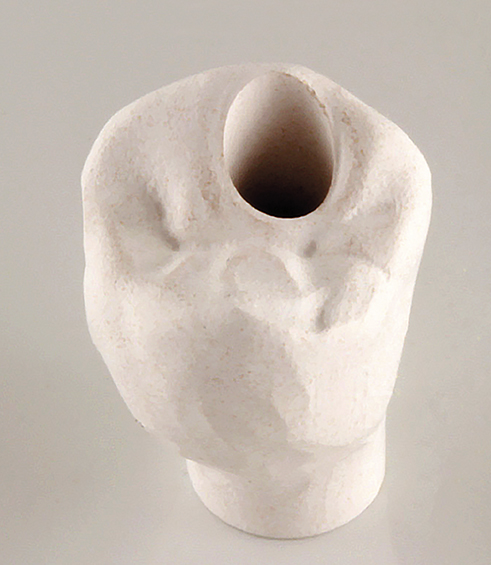
After the construction, the abutment crown was milled from NexxZr T Multi (Sagemax). Special feature: The multi-layer zirconium oxide combines two generations of zirconium oxide (3Y-TZP and 5Y-TZP). This results in a high flexural strength (1170 MPa) in the cervical region that is associated with high incisal translucency. Unlike some other multi-layer zirconium oxides, NexxZr T Multi has a smooth colour and translucency gradient and is free of visible layers. As a result, the restorations appear very natural and in many situations monolithic implementation without aesthetic compromises is possible. To be able to optimally utilize the colour gradient, when nesting ensure that the crown is correctly positioned in the milling blank. Morphological details are touched up after the milling. Caution: Zirconium oxide is a “delicate petal”. Particularly in the white chalk-like state (before sintering), it must be handled with care. Do not use laboratory turbines or steam.
To conceal the titanium base, the crown is coated inside the screw channel with a light blocker (LightBlock, Briegel Dental). This opaque liquid prevents the titanium base showing through without negatively affecting the translucency of the zirconium oxide. During the sintering, the liquid diffuses into the zirconium oxide and masks the titanium base.
Completing the abutment crown
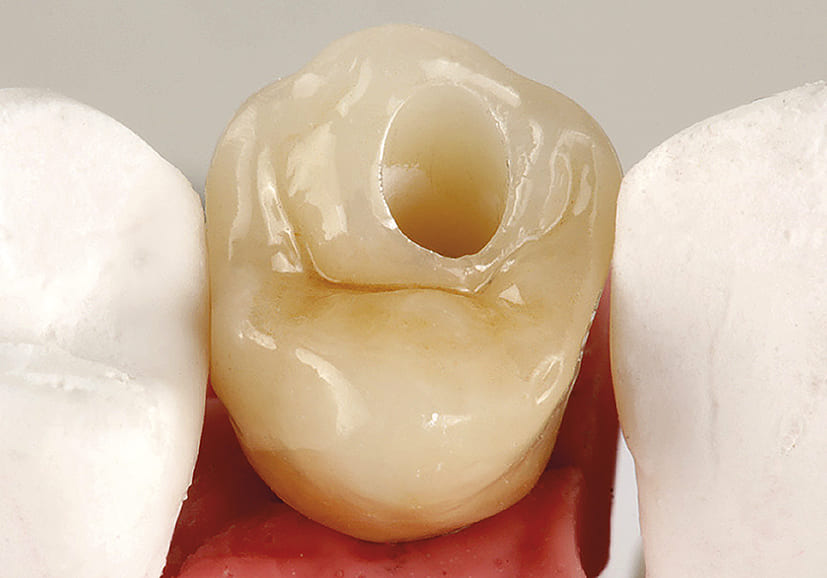
The sintered crown (NexxZr T Multi) showed the usual good fit and after the sintering had wonderful optics and a smooth colour gradient. The vestibular veneering (ZI-CT, Creation) was performed in five steps. For the first firing – Frame Shade bonding agent – the veneering surface was coated with a high-fusing, fluorescing ceramic material. The second firing is similar to the wash firing. Using the sprinkle technique, fluorescing shoulder material was sprinkled onto the framework. This produces a slightly roughened or glazed surface that creates vivid colours and supports the bond between the zirconium oxide and the veneering ceramic. For the dentin firing, the crown was coated with the dentin and enamel materials. Because NexxZr T Multi has a tooth-like colour already, only a thin veneer layer is necessary. This step was followed by a corrective firing and, after working the surface texture, by the final glaze firing.
Cementation of the titanium base and insertion
Cementing a crown to the titanium base requires a reliable protocol because the bond determines the long-term success. Blasting and conditioning of the titanium base and the zirconium oxide adhesive surface and cementation with the luting composite (Multilink Hybrid Abutment, Ivoclar) were performed according to the information from the manufacturer. Thorough removal of residual composite near the cementation joint followed manual polishing of the basal parts. A certain micro-roughness is recommended in the transmucosal area to encourage the growth of the gingiva while at the same time counteracting the deposition of plaque [3]. A final check on the model confirms the fit and correct adjustment of the proximal contact surfaces. The restoration was sent to the practice and screwed occlusally into the patient’s mouth.
Conclusion
The exceptionally natural appearance of the light optics of the hybrid abutment crown is confirmed intraorally. The restoration appears warm and vibrant from the inside out. The titanium base is completely concealed; nevertheless, the crown has a beautiful translucency. In theory, NexxZr T Multi and its colour and translucency gradient allow the fabrication of monolithic restorations. Because the aesthetic demands in this case were high, vestibular thin-layer veneering was carried out. The functional surfaces remain monolithic, which provides a high level of protection against chipping. The expectations of the patient were met in full. The implant dentistry therapy is successfully completed. At the same time, this efficient method of fabrication is in accord with the economic requirements of the dental laboratory.
Dental implementation of the work: Dr med. dent. Katharina de Buhr, Zahnwerk Westerstede www.zahnwerk-westerstede.de
References
[1] Gehrke P, Dhom G, Brunner J, Wolf D, Degidi M, Piattelli A. Zirconium implant abutments: fracture strength and influence of cyclic loading on retaining-screw loosening. Quintessence Int 2006; 37:19–26
[2] Gehrke P, Johannson D, Fischer C, Stawarczyk B, Beuer F. In vitro fatigue and fracture resistance of one- and two- piece CAD/CAM zirconia implant abutments. Int J Oral Maxillofac Implants 2015; 30:546–554.
[3] Gehrke P, Kaiser W, Fischer C. Comparative analysis of surface topography of custom of CAD/CAM zircona abutments by means of optical profilometry.
In progress.
[4] Stimmelmayr M, Sagerer S, Erdelt K, Beuer F. In vitro fatigue and fracture strength testing of one-piece zirconia implant abutments and zirconia implant abutments connected to titanium cores. Int J Oral Maxillofac Implants 2013; 28:488–493.
[5] Yilmaz B, Salaita LG, Seidt JD, McGlumphy EA, Clelland NL. Load to failure of different zirconia abutments for an internal hexagon implant. J Prosthet Dent 2015; 114:373–377.